
Should You Pay Off Debt or Invest? How to Make the Decision
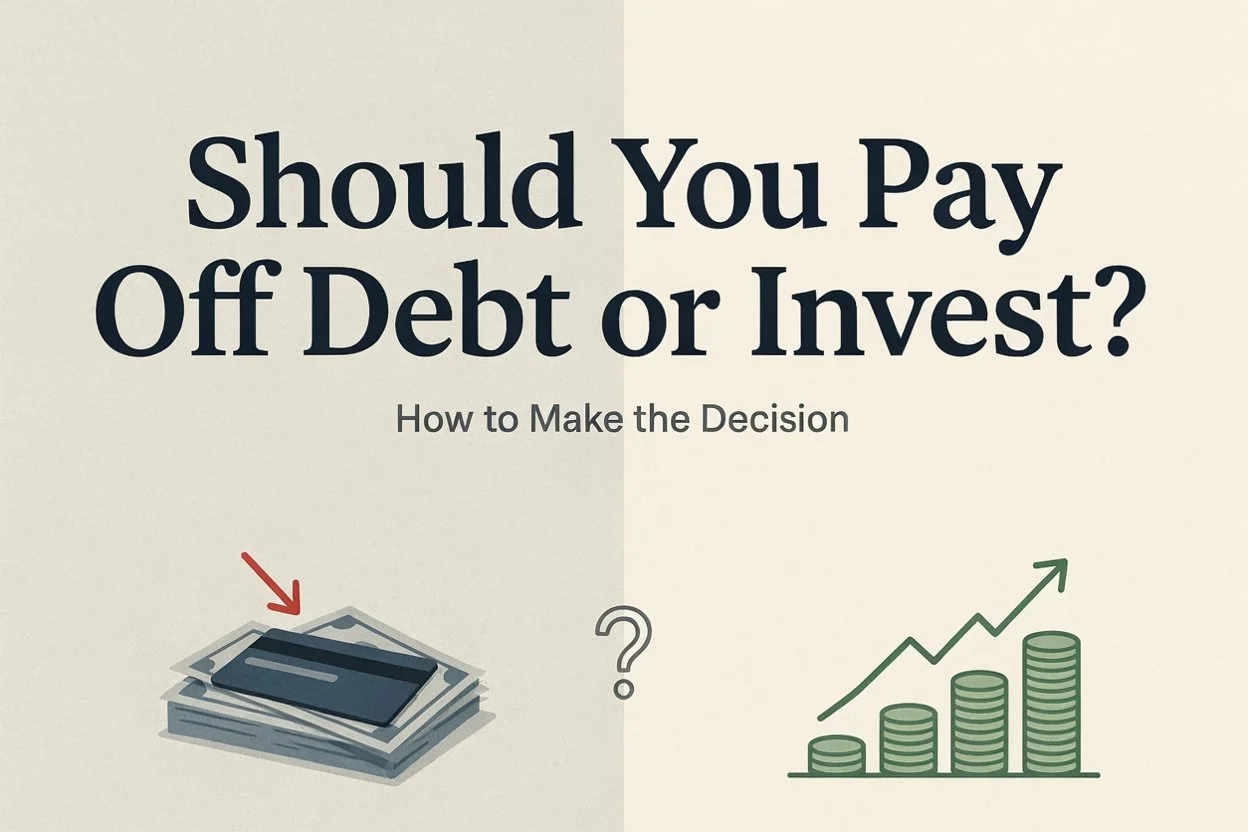
If you have extra money each month, you’re choosing between two things: eliminating a guaranteed cost (interest on debt) or pursuing an uncertain but potentially larger return (investing). Neither choice is universally correct. The right answer depends on your interest rates, your risk tolerance, your tax situation, and how stable your income and expenses are.
This article walks through the factors that actually drive this decision, with a comparison framework and a worked example, so you can apply it to your own numbers.
The Core Trade-Off
Every dollar you put toward extra debt payments earns a guaranteed “return” equal to your interest rate, because that’s the cost you avoid paying. Every dollar you invest instead earns an uncertain return that depends on market performance.
This means the comparison isn’t really “debt vs. investing” in the abstract — it’s a comparison between a known rate and an unknown one. The higher your debt’s interest rate, the harder it is for investing to beat it consistently. The lower your debt’s interest rate, the more room there is for investing to make sense.
Start With the Interest Rate on Your Debt
Interest rates on debt vary widely by type:
| Debt Type | Typical Rate Range* |
|---|---|
| Credit cards | Often 18%–29% |
| Personal loans | Often 7%–25% |
| Auto loans | Often 5%–12% |
| Federal student loans | Often 4%–8% |
| Mortgages | Often 5%–8% |
*Rates vary by lender, credit profile, loan type, and current market conditions. Check your loan documents or lender statements for your actual rate — don’t rely on general ranges to make your decision.
As a general principle: debt with a double-digit interest rate is very difficult to “beat” with investment returns over time, since long-run stock market returns have historically averaged in the high single digits before inflation, and that average masks significant year-to-year volatility. Debt in the 4%–7% range is a closer call, and the decision depends more on the other factors below.
Other Factors That Matter
1. Whether You Have an Emergency Fund
Before weighing debt payoff against investing, most financial guidance points to building a basic emergency fund first — commonly cited as three to six months of essential expenses, though the right amount depends on job stability and household circumstances. Without one, an unexpected expense can force you into new high-interest debt, undoing any progress from either strategy.
2. Employer Retirement Match
If your employer matches retirement contributions (for example, a 401(k) match), contributing enough to get the full match is often worth prioritizing before extra debt payments. A full match is an immediate, guaranteed return on that contribution — frequently higher than the interest rate on most debt. Not capturing an available match is leaving guaranteed money unclaimed.
3. Tax Treatment
Some debt carries tax-deductible interest in certain circumstances (for example, mortgage interest or student loan interest, subject to IRS limits and phase-outs that depend on your income and filing status). Some investment accounts offer tax-deferred or tax-free growth (traditional or Roth retirement accounts). These tax effects change the real, after-tax cost of debt and the real, after-tax return on investing — so they matter, but the specifics depend on current tax law and your personal situation. Consult current IRS guidance or a tax professional for numbers specific to your case.
4. Risk Tolerance and Time Horizon
Paying off debt has a certain outcome: your balance goes down, and you stop paying interest on the amount you paid off. Investing has an uncertain outcome over any short period — markets can decline for months or years before recovering. If a market downturn during the years you’re investing would cause you significant financial or psychological stress, that’s a real cost, even if the “expected” long-run return favors investing.
Time horizon matters too. Money you’ll need within the next few years is generally more suited to paying down debt or keeping in a stable account than to investing in assets that can fluctuate in value.
5. Cash Flow and Peace of Mind
Some people place a real value on being debt-free that goes beyond the math — reduced monthly obligations, more flexibility if income changes, and less mental load. This isn’t irrational; it’s a legitimate factor in the decision, particularly for revolving debt like credit cards where minimum payments can persist indefinitely if the balance isn’t addressed.
A Simple Decision Framework
You can approach the decision in this order:
- Cover essential expenses and build a starter emergency fund (even a small one, before optimizing further).
- Capture any full employer retirement match — this is generally a very high, low-risk return.
- Pay off high-interest debt (commonly considered debt at rates similar to credit cards, and other unsecured debt in that range) — this is a very difficult return to beat elsewhere.
- For remaining moderate-rate debt (roughly the mid-single-digit to low double-digit range), split the decision based on your risk tolerance, tax situation, and how much you value being debt-free versus building long-term investment balances.
- For low-rate, tax-advantaged debt (some mortgages or subsidized student loans), consider investing more of your extra cash, since the guaranteed “return” from paying it off early is comparatively low — but only after your higher-priority items above are addressed.
Many people do a mix rather than an all-or-nothing choice: for example, making extra payments on high-rate debt while still contributing enough to capture an employer match.
Worked Example
Assumptions:
- Debt balance: $8,000
- Interest rate: 19% (credit card)
- Extra amount available: $200/month
- Alternative: investing that same $200/month
At 19% interest, paying an extra $200/month toward this balance (on top of the minimum payment) would reduce the payoff timeline and the total interest paid substantially compared to making only minimum payments — the exact figures depend on your current minimum payment and how the issuer applies extra payments, so it’s worth confirming with your card issuer that extra payments go directly to principal.
By contrast, for that same $200/month to “beat” a 19% guaranteed return through investing, it would need to consistently earn more than 19% annually after taxes and fees — a rate of return that is far above typical long-run market averages and would involve considerably more risk and volatility than most investors are looking to take on.
This is why high-interest debt is usually the priority: the guaranteed return from paying it off is higher than what most investment strategies can reliably deliver.
Contrast case:
- Debt balance: $200,000
- Interest rate: 5.5% (mortgage)
- Extra amount available: $200/month
Here the comparison is closer. A 5.5% guaranteed “return” from extra mortgage payments is reasonable, but historically, diversified stock investments have sometimes outperformed that rate over long periods — while also carrying real risk of underperforming it, especially over shorter periods. Whether extra payments or investing makes more sense here depends heavily on your time horizon, whether the interest is tax-deductible for you, and your comfort with investment risk.
Common Mistakes to Avoid
- Treating all debt the same. A 24% credit card and a 4% subsidized student loan call for very different strategies.
- Ignoring an employer match to pay down low-rate debt. This often means giving up a larger guaranteed return to pursue a smaller one.
- Investing while carrying high-interest debt with no emergency fund. A single unexpected expense can force new high-interest borrowing, erasing investment gains.
- Assuming past investment returns are guaranteed going forward. Historical averages are not a promise of future performance.
- Overlooking prepayment penalties. Some loans charge a fee for paying off the balance early — check your loan agreement or servicer before making large extra payments.
When Paying Off Debt Makes More Sense
- Your debt carries a high interest rate (commonly credit cards or high-rate personal loans).
- You don’t have an emergency fund yet.
- You value the certainty and reduced obligation of being debt-free.
- Your income or job situation is unstable, and reducing fixed monthly payments would help.
When Investing Makes More Sense
- Your debt has a low, often tax-advantaged rate (some mortgages, some student loans).
- You have an emergency fund in place.
- You’re already capturing any employer retirement match.
- You have a long time horizon and can tolerate market fluctuations without it affecting your financial stability.
Practical Next Steps
- List each debt with its balance, interest rate, and minimum payment.
- Check whether you have an employer retirement match available and whether you’re capturing it in full.
- Confirm whether any of your debt has tax-deductible interest or prepayment penalties.
- Decide how much of your extra monthly cash flow to send toward debt versus investing, using the framework above.
- Use the Loan Payoff Calculator to see how different extra-payment amounts change your specific payoff date and total interest — this can help you see exactly what “paying off debt” is worth in your situation before comparing it to investing.
FAQ
Is it ever better to invest even with high-interest debt?
It’s uncommon, mainly because few reliable investments consistently outperform double-digit interest rates after taxes and fees. Some people still choose to invest a portion for psychological or diversification reasons, but the math generally favors paying off high-rate debt first.
Should I pay off my mortgage early instead of investing?
It depends on your mortgage rate, whether the interest is tax-deductible for you, and your risk tolerance. There isn’t a universal answer — run the specific numbers for your loan and compare them to your expected investment return and comfort with risk.
What if I have multiple debts at different rates?
A common approach is prioritizing the highest-rate debt first (often called the “avalanche” method) to minimize total interest paid, though some people prefer paying off smaller balances first for motivation (the “snowball” method), even if it’s not mathematically optimal.
Does paying off debt early hurt my credit score?
Paying off installment debt (like a personal loan) can sometimes cause a small, temporary dip in credit mix or average account age, but the effect is generally minor. Paying down revolving debt (like credit cards) typically helps your credit utilization ratio, which is a significant factor in most credit scoring models.
Can I do both at the same time?
Yes. Many people split extra cash flow — for example, contributing enough to capture an employer match while also making extra payments on high-interest debt. You don’t have to choose one strategy exclusively.
How do I know if my investment returns will actually beat my debt’s interest rate?
You don’t know in advance — investment returns are not guaranteed. This uncertainty is exactly why higher-interest debt is generally prioritized: it offers a certain “return” (interest saved) that many investments can’t reliably match.
Conclusion
The decision between paying off debt and investing comes down to comparing a guaranteed return (interest avoided) against an uncertain one (investment growth), while factoring in your emergency fund status, any employer match, tax treatment, and your personal risk tolerance. High-interest debt is usually the priority since few investments reliably beat it. Lower-rate, tax-advantaged debt leaves more room for investing, but the right split depends on your specific numbers. Use the Loan Payoff Calculator to model your own balance, rate, and extra-payment scenarios before deciding how to allocate your extra cash flow.



About Author
Blake is a personal finance blogger who writes about loan repayment strategies, debt management, and practical ways to pay off loans faster. He focuses on simplifying complex loan concepts using real-world examples and easy-to-use financial tools through LoanPayoffCalc.com. Learn More