Should You Pay Off a Loan Early or Keep the Money in Savings?
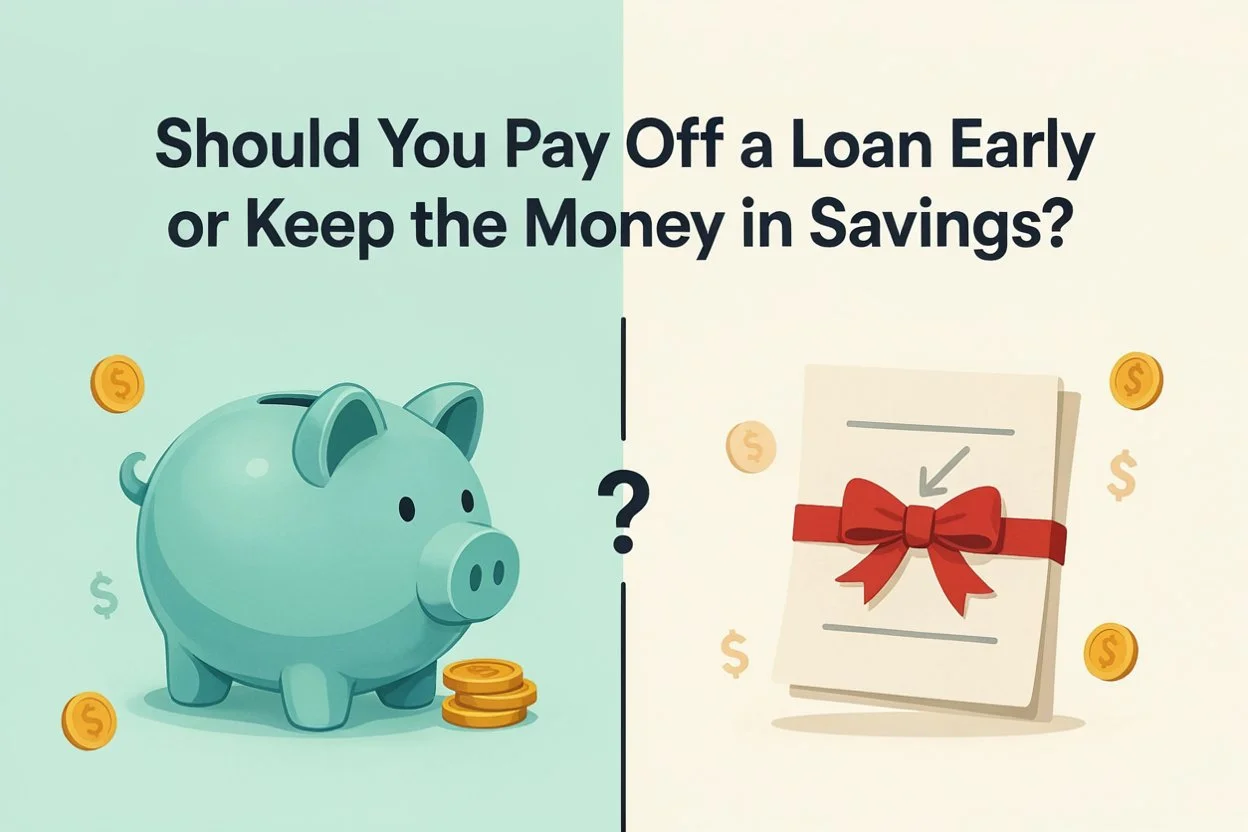
You have a lump sum, whether a bonus, a tax refund, or savings you’ve built up. You also have a loan costing you interest every month. The question is whether to pay off the loan or keep the money in savings.
The answer depends on three things: the interest rate on your loan, what your savings earn after taxes, and how much cash you’d have left if something unexpected happened. This article covers how to compare those, works through a numerical example, and lists the situations where each choice makes more sense.
The Short Answer
A rough rule works for most borrowers:
- If your loan rate is clearly higher than your savings yield, and you’d still hold a solid emergency fund afterward, paying down the loan usually comes out ahead on paper.
- If your loan rate is close to or below your savings yield, keeping the cash is often the better financial choice, and it keeps your options open.
- If paying off the loan would leave you with little or no cash reserve, the rate comparison matters less than the risk of needing to borrow again, often at a higher rate.
The rest of the article explains why, and where the exceptions are.
What You’re Actually Comparing
Paying down a loan and holding savings are both ways to use the same dollar. Three things separate them.
A guaranteed return versus a variable one. Every dollar you put toward the principal of a fixed-rate loan stops accruing interest at that loan’s rate. That saving is certain, because it doesn’t depend on markets or on a bank keeping its savings rate high. A savings account rate, by contrast, can change at any time.
Pre-tax versus after-tax. Interest earned in a regular savings account is generally taxable income. Interest you avoid paying on a loan is usually not a taxable event, though in some jurisdictions and for some loan types the interest you pay may be deductible. Tax treatment varies by country, state, and loan type, so check the rules that apply to you. For illustration, a 4% savings yield taxed at a 25% marginal rate would keep about 3% after tax. Comparing 4% against an 8% loan rate would overstate what savings are earning you.
Liquidity. Savings can be spent tomorrow. Money sent to a loan generally cannot be taken back out. Once you’ve paid down a balance, getting the cash back means borrowing again, which may require approval, fees, or a higher rate than you had before. Liquidity is the most common reason people choose to hold cash even when the math favors payoff.
A Worked Example: $10,000 Lump Sum
The table below compares the two choices using one set of assumptions. All figures come from standard amortization and compound-interest formulas and are rounded.
Example assumptions
- Loan balance: $20,000
- Interest rate: 8% APR, fixed
- Remaining term: 60 months
- Required monthly payment: $405.53 (paid at the end of each month)
- Lump sum available: $10,000
- Savings rate: 4% per year, compounded monthly, ignoring taxes
- Scenario A: the $10,000 goes to principal now, and you keep paying $405.53 a month until the loan is gone. After that, the same $405.53 goes into savings each month.
- Scenario B: the $10,000 stays in savings, and you make the regular payments for all 60 months.
In both scenarios you spend $405.53 a month on this loan or on savings, so the comparison is fair on monthly cash flow.
| A: Lump sum to loan | B: Keep in savings | |
|---|---|---|
| Loan paid off | About month 28 | Month 60 |
| Interest paid on the loan from today | About $961 | About $4,332 |
| Interest earned on savings over 5 years | About $740 | About $2,210 |
| Savings balance at month 60 | About $14,100 | About $12,200 |
In this example, Scenario A ends up roughly $1,900 ahead after five years. The extra payment shortens the loan enough that the freed-up monthly payment gets several years to grow in savings.
Some caveats matter here:
- This is one example, not a universal result. Change the loan rate, the savings yield, or the term, and the gap changes.
- Taxes would narrow the gap. Interest on the savings side is generally taxable, which lowers Scenario B’s ending balance further, so this example understates the advantage of paying down the loan slightly. If your loan interest is deductible, the gap would narrow in the other direction.
- Scenario B looks safer for the first two years. During months 1 through 27, the saver holds an extra $10,000 in cash while the payer holds none. Whether that cushion is worth about $1,900 is a personal risk decision, not just a math problem.
- Real lenders differ. Payment timing, how extra payments are applied, and daily versus monthly interest calculation can all shift the numbers slightly.
To test your own figures, the Loan Payoff Calculator lets you enter a lump sum or recurring extra payment and see the new payoff date and total interest side by side with your current schedule.
When the Rate Gap Is Small or Reversed
The example above had a wide gap between an 8% loan and a 4% savings account. The decision gets less clear as the gap narrows.
A one-percentage-point difference on $10,000 is roughly $100 a year before taxes. That’s real money, but small enough that the value of having cash on hand can easily outweigh it. If your savings account pays more than your loan costs, keeping the cash and making regular payments earns you more on paper.
Two things to check before deciding that way:
- Is the savings rate temporary? Some accounts pay a promotional rate that drops after a few months. Others follow a benchmark and can fall quickly. A fixed loan rate stays put, so a savings yield that is higher today may not stay higher.
- Is the loan rate fixed or variable? A variable-rate loan can rise, which strengthens the case for paying it down. A fixed-rate loan with a low rate makes it easier to hold cash.
Factors Beyond the Interest Rate
Your emergency fund comes first
If putting the lump sum on a loan would drain your reserves, that changes the picture. A common target is several months of essential expenses. The right amount depends on your income stability, dependents, and other safety nets, so there is no single number that fits everyone.
Without a cushion, an unplanned expense such as a car repair, medical bill, or gap in income can push you into credit card debt or a new loan. That new borrowing can easily cost more than the interest you saved. If a lump sum would leave you thin on cash, splitting it between the loan and savings is often more sensible than choosing one side.
Prepayment penalties and lender rules
Some loans charge a fee for paying off a balance early. The Consumer Financial Protection Bureau notes that on mortgages, a prepayment penalty typically applies to paying off the whole balance within a set number of years, usually three or five, and may sometimes apply to a large one-time payment. Small extra principal payments usually don’t trigger it, but confirming with the lender is a good idea. Not all loans have these penalties. Rules differ by loan type, lender, and country, so read your loan agreement before sending a large payment.
Also confirm how the lender applies extra money. Some servicers treat an unlabeled extra payment as an early installment on the next month’s bill instead of a reduction of principal. If it doesn’t hit principal, it doesn’t save interest in the way you expect. Look for a principal-only or “additional principal” option, and check your next statement to confirm.
Whether the loan will shorten or the payment will drop
Most lenders keep your monthly payment the same and end the loan sooner when you prepay. That saves the most interest. A few loan types, notably some mortgages, can be recast after a large payment to lower the monthly amount, often for a fee. If your goal is a lower monthly payment rather than a faster payoff, ask whether that option exists.
Other debts with higher rates
If you have several debts, the loan you’re considering may not be the best target. A balance at a higher interest rate elsewhere, such as a credit card, saves more per dollar than one at a lower rate. Comparing them by rate helps you put the money where it earns the largest guaranteed return.
Cash flow and peace of mind
For some borrowers, eliminating a monthly payment is valuable in itself, because it lowers required expenses and makes income shocks easier to absorb. That’s a legitimate reason to pay off a loan even when the rate gap is small. It’s a different argument than the math, and it’s fine to weigh it separately.
Credit score effects
Closing an installment loan can change a credit score slightly, and the direction and size vary by person and by the rest of the credit file. It isn’t a reason to carry debt you can comfortably eliminate, but if you’re about to apply for a mortgage or another major loan, it’s worth timing the payoff with that in mind.
A Middle Path: Splitting the Money
Choosing between all-in on the loan and all-in on savings is not required. Many borrowers find a split works better. For instance:
- Build or top up the emergency fund to a level you’re comfortable with first.
- Put the remainder toward the loan.
- Keep making extra monthly payments from ongoing income once the cash cushion feels adequate.
Regular small extras also keep your savings flexible. Even modest additional principal payments shorten the loan and reduce total interest over time, with less risk to your liquidity.
Common Mistakes
Comparing the loan rate to the wrong number. Use your actual after-tax savings yield, and remember that a promotional rate may not last.
Draining savings to pay off a low-rate loan. If the rate is modest, the interest saved may not justify losing your safety net.
Assuming extra money goes to principal. Confirm how your lender applies it, and check the next statement.
Ignoring prepayment terms. Read the loan agreement before making a large payment, especially on mortgages, auto loans, and personal loans.
Ignoring a higher-rate debt. The best use of a lump sum is usually the balance costing you the most.
Treating the decision as permanent. If you keep making required payments and hold cash, you can still send a lump sum later, once your situation is clearer.
A Practical Way to Decide
- Write down the numbers. Loan balance, rate (fixed or variable), remaining term, and any prepayment terms.
- Find your after-tax savings yield. Use the rate you’re actually earning, not a headline number.
- Check the emergency fund. Decide how much cash you want to keep no matter what.
- Compare the spread. If the loan rate is well above your after-tax yield, payoff gains strength. If it’s close or lower, holding cash gains strength.
- Model both options. Use the Loan Payoff Calculator to see how a lump sum or extra monthly payment changes the payoff date and total interest.
- Split if unsure. Doing part of each is a reasonable answer when the math and your comfort level point in different directions.
Frequently Asked Questions
Will a lump-sum payment lower my monthly payment?
Usually not. Most lenders keep the payment the same and shorten the loan. Some loans, notably certain mortgages, allow a recast that lowers the payment after a large payment, often for a fee. Ask your lender which applies.
Is it better to make extra monthly payments or one large payment?
A large payment early reduces principal sooner, so it typically saves more interest. Smaller recurring extras keep more cash available and still add up. Which is better depends on how much liquidity you want to keep.
My savings account pays more than my loan costs. Should I still pay the loan?
On paper, keeping the cash earns more. Two things can change that: if the savings rate is promotional or variable, and if the loan rate is variable and might rise. Paying it off can still make sense if the peace of mind is worth more to you than the small difference.
What if I also have credit card debt?
Credit card balances usually carry higher rates than installment loans, so paying them first generally saves more. Compare the actual rates on your own accounts before deciding.
Will paying off a loan early hurt my credit?
It can cause a small change in either direction, depending on the rest of your credit file. It’s rarely a reason to keep a loan you’d otherwise pay off, but it’s worth considering if you plan to apply for major credit soon.
How do I make sure my extra payment reduces principal?
Check whether your lender or servicer offers a principal-only payment option, follow their instructions for making one, and confirm on your next statement that the balance dropped by the amount you sent.
Conclusion
Whether to pay off a loan or keep money in savings comes down to comparing an after-tax savings yield with a loan rate, then adjusting for how much cash you need to hold. When the loan rate is well above what your savings earn and your emergency fund stays intact, paying down the loan is usually the stronger move. When the rates are close, or the payoff would leave you exposed, holding cash or splitting the money is often wiser.
Before you decide, look at your loan agreement for prepayment terms, confirm how extra payments are applied, and run your own numbers. The Loan Payoff Calculator shows how different lump sums or monthly extras change your payoff date and total interest, so you can compare the options with your real figures.

About Author
Blake is a personal finance blogger who writes about loan repayment strategies, debt management, and practical ways to pay off loans faster. He focuses on simplifying complex loan concepts using real-world examples and easy-to-use financial tools through LoanPayoffCalc.com. Learn More